
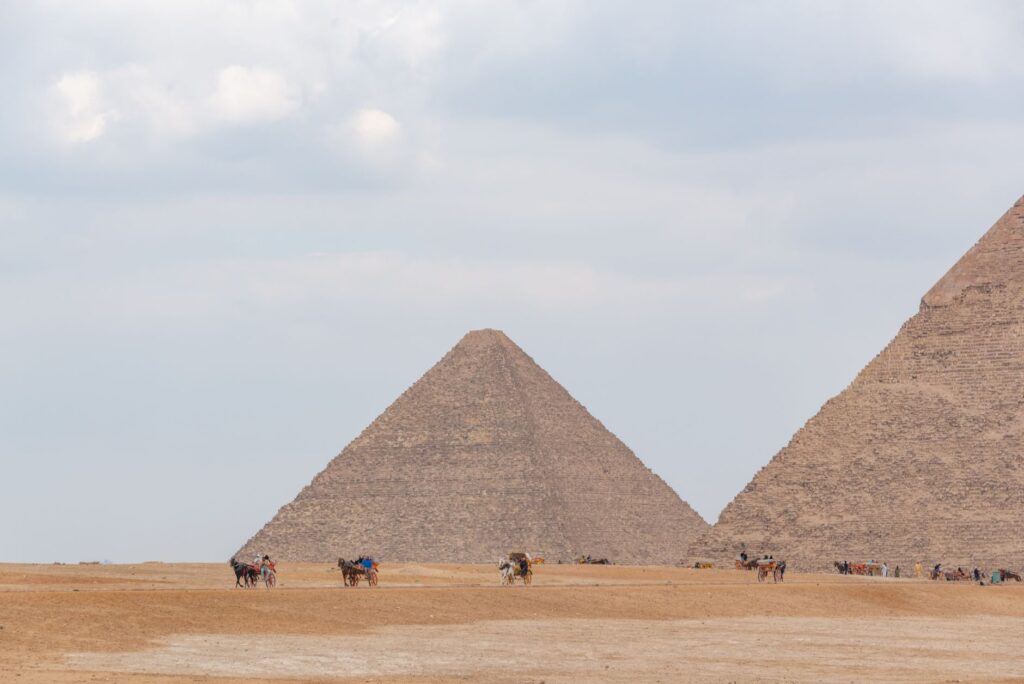
Egypt is history you can walk through — the Pyramids of Giza, Luxor’s temples, a Nile cruise and Red Sea reefs. A travel eSIM connects you before you land at Cairo (CAI), Hurghada or Sharm el-Sheikh: buy online, scan a QR code from your email, done. New to eSIMs? Start with what an eSIM is and how it works.
Why an eSIM beats roaming in Egypt
Roaming from home can mean punishing daily fees or per-megabyte billing. A local-network eSIM is one fixed price for a data bundle, paid up front — nothing to settle later. See eSIM vs roaming: what international data really costs.
Mobile networks & coverage in Egypt
Egypt is served by Vodafone, Orange, Etisalat (e&) and WE. Turnaa plans connect through partners and lock onto the strongest available signal automatically; the operator is shown in each plan’s details drawer. Coverage is strong in cities, along the Nile and at Red Sea resorts, thinning in the open desert.
Best Egypt eSIM plans right now
Prices are live and shown up front — pick your data size (our how-much-data guide helps).
| Data | Data type | Duration | Price |
|---|---|---|---|
| 0.1 GB | Standard | 7 days | $2.99 |
| 0.5 GB | Standard | 7 days | $5.05 |
| 0.5 GB/day | Unlimited | 1 day | $5.05 |
| 1 GB | Standard | 7 days | $5.75 |
| 1 GB/day | Unlimited | 1 day | $6.20 |
How to install and activate
- Buy your plan — the QR code arrives by email within seconds.
- On Wi-Fi, open Settings → Cellular → Add eSIM and scan it. Guides for iPhone and Android, plus a quick check of which devices support eSIM.
- On landing, select the eSIM for data and enable data roaming for that line. Your home number stays live — keep your number and WhatsApp.
Where to go — and staying connected across Egypt
- Cairo & Giza — the Pyramids, the Sphinx and the Grand Egyptian Museum.
- Luxor & Aswan — Karnak, the Valley of the Kings and a Nile felucca cruise.
- The Red Sea — Hurghada and Sharm el-Sheikh for diving and beaches.
- Alexandria — Mediterranean coast, the library and Greco-Roman ruins.
Adding more of the region? See one eSIM for Middle East travel.
What to eat in Egypt
Egyptian street food is cheap and delicious. Try koshari (rice, pasta and lentils), ful medames and ta’meya (Egyptian falafel), grilled shawarma, and molokhia, all washed down with sweet mint tea or fresh sugar-cane juice.
Local customs, rules & sensitivities
- Dress modestly — cover shoulders and knees; women should carry a scarf for mosques.
- Baksheesh (tipping) is a way of life — keep small notes for help, service and photos.
- Bargain hard in bazaars like Khan el-Khalili; the first price is never the real one.
- Drink bottled water, and respect Ramadan fasting hours in public.
- Ask before photographing people, and avoid military or government sites.
Egypt data tips from the road
- Download offline maps before desert and Nile-side excursions.
- Airport SIM counters take your passport and charge tourist rates; an eSIM skips both.
- Translation apps help — English fades fast outside tourist zones.
FAQ
How much data do I need for a Egypt trip?
Maps, messaging and social sit around 3–5 GB a week; more for streaming. See our data guide.
Does it work at the Red Sea resorts?
Yes — Hurghada and Sharm el-Sheikh are well covered; only the deep desert has gaps.
Do I keep my regular phone number?
Yes — the eSIM is a data-only line; your home SIM stays active for calls and texts, bank codes included.
What if it doesn’t work when I land?
Usually two settings: select the eSIM for data and enable data roaming (see troubleshooting). Support replies fast, and unactivated plans are refundable within 24 hours.